Many foragers go to the forest only in September, although mushrooms grow there almost all year. Different species fruit in each season. This guide describes the mushroom year from the first spring species to those that tolerate frost.
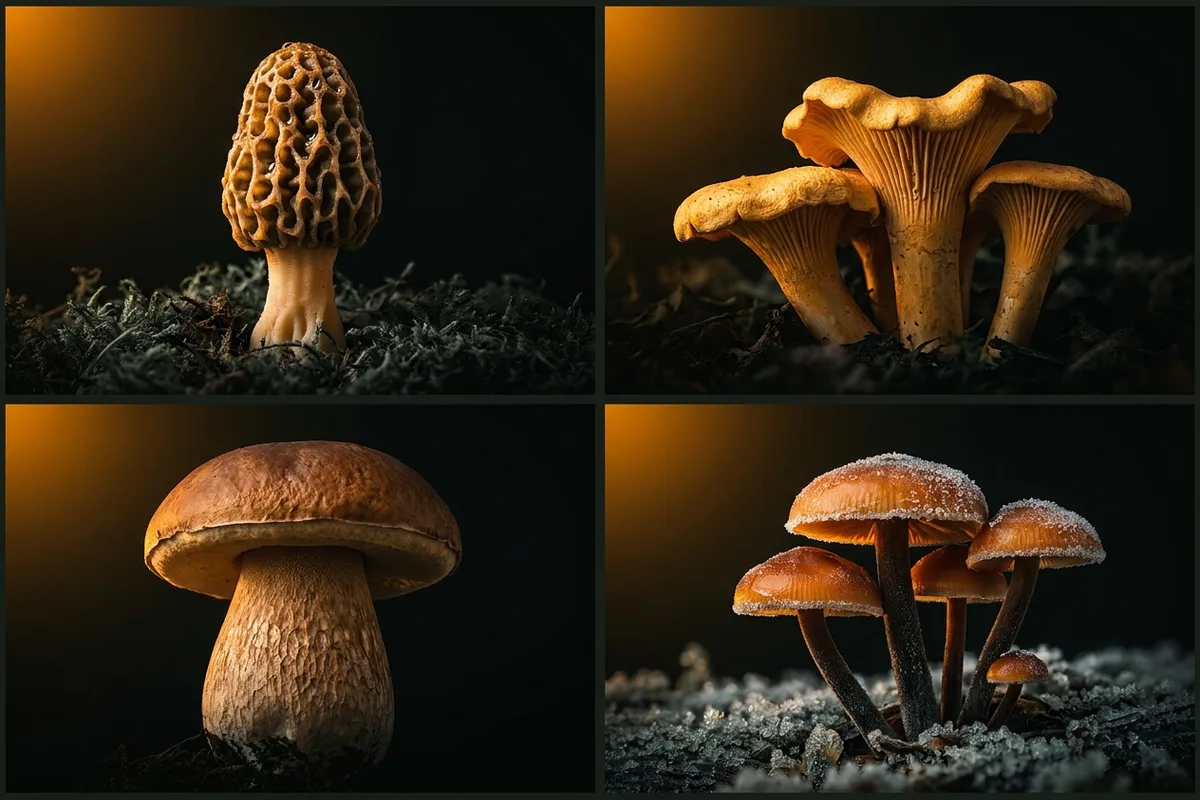
Spring: March to June
Spring species appear earlier than most foragers think. Scarlet elf cups grow on fallen branches as early as March, and morels and thimble morels fruit in April and May. Morels are legally protected in Poland, so picking them is prohibited. The false morel grows at the same time. It is deadly poisonous, and foragers easily mistake it for a morel. The first chanterelles appear at the end of June.
Sarcoscypha austriaca, the scarlet elf cup, grows on fallen branches from January to April.
Morchella esculenta, the morel, grows in April and May. It is protected, so you may not pick it.
Gyromitra esculenta, the false morel, grows from March to May. It is deadly poisonous and easy to mistake for a morel.
The first Cantharellus cibarius, chanterelles, appear at the end of June.
Summer: July and August
In summer chanterelles are at their height, and porcini and bay boletes appear in large numbers for the first time. Summer is a good time to learn identification, because there are many species and the competition from other foragers is not yet as strong as in September. After heavy summer storms, fruit bodies usually appear one to two weeks later.
Cantharellus cibarius, chanterelles, are in full season.
Imleria badia, the bay bolete, is one of the most common species.
Boletus edulis, the porcini, appears in large numbers for the first time.
Leccinum and Suillus, scaber stalks and slippery jacks, grow especially under birch and pine.
Autumn: September and October
September and October are the peak of the mushroom season, and most foragers go to the forest in these months. Summer species grow together with typical autumn species, so the harvests are at their largest. As temperatures fall, species appear that did not grow earlier in the year.
Boletus edulis, the porcini, grows most abundantly at this time.
Armillaria mellea, honey fungus, grows in clusters on stumps and roots.
Lactarius deliciosus, the saffron milk cap, grows in pine woods.
Macrolepiota procera, the parasol, grows in meadows and at forest edges.
Late autumn and winter: November onward
After the first frosts most species stop fruiting, but a few species continue to grow. They are adapted to the cold and appear when other species no longer fruit. Harvests in this period are smaller.
Flammulina velutipes, the velvet shank, withstands frost.
Pleurotus ostreatus, the oyster mushroom, grows on dead deciduous wood.
Hygrophorus hypothejus, the herald of winter, grows in pine woods until December.
This overview is arranged by season. The season calendar shows every atlas species week by week: when it starts, when it peaks, when it ends and which poisonous look-alikes grow at the same time.
How to read the season calendar
The calendar splits each species’ season into three phases. “Coming into season” lists species that have started to grow or will start within three weeks. “Peak” covers the weeks that hold half of all the year’s reports of the species. “Ending” lists species past their peak, whose season closes within a few weeks.
The thickness of the bar next to a species shows how often foragers report it and does not indicate how much of it grows. The calendar therefore tells you when a species usually fruits. Whether it fruits this week depends on the weather: most species produce fruit bodies one to two weeks after a heavy rain, when it is warm but not hot.
The guide explains how rain, temperature and frost shift a flush and how to read the conditions index in the app.
Some valuable species, such as morels, are legally protected in Poland and must not be picked. The list is updated from time to time, so before you put something rare in your basket, make sure that species may be legally collected. Protection also applies to places: reserves and national parks have their own rules.
A calendar is only a starting point, because every year is different. A warm, wet autumn shifts the flushes, and a drought delays them. Your own log of finds from previous years holds the most information about your spots. After a few seasons you can predict the flushes at your spots more accurately than a general table allows.