The parasol is one of the most rewarding mushrooms for beginners, because a mature specimen is large and distinctive. Young specimens are harder to identify, since an inexperienced forager can confuse them with the death cap. Such a mistake can be deadly, because the death cap is responsible for most fatal mushroom poisonings in Europe.
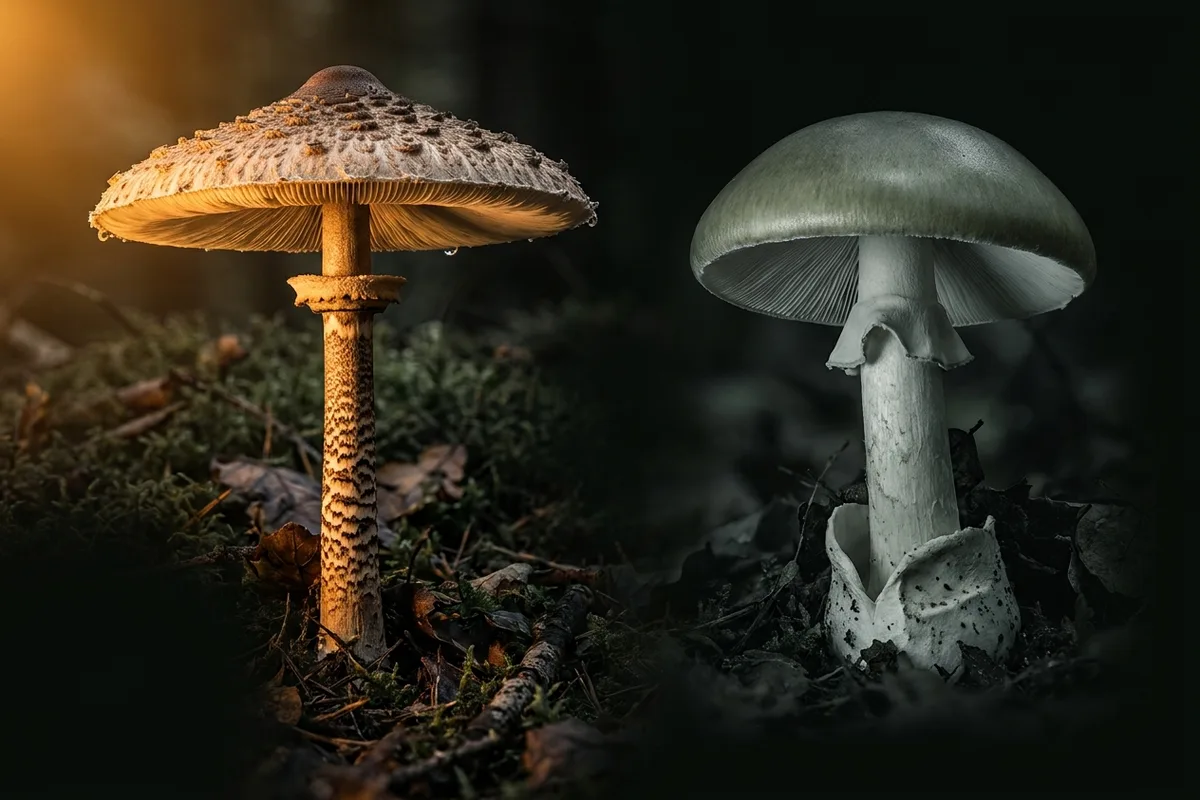
What a mature parasol looks like
A fully grown parasol, Macrolepiota procera, resembles an umbrella on a tall stem. The cap can be over twenty centimetres wide. It is light brown, covered with concentric, raised scales, and has a distinct darker umbo in the centre. The gills are cream-white and free, meaning they do not reach the stem.
Two stem features matter most. The first is the pattern: the parasol stem carries a brown, snake-like design, sometimes called snakeskin. The second is the ring, which on the parasol is double, thick and movable. You can gently slide it up and down the stem with your fingers. The death cap has neither of these features.
What the death cap looks like
The death cap, Amanita phalloides, has a smooth cap in olive-green shades, sometimes with paler fibrils, without the raised scales of a parasol. The gills are white, as in a young parasol, so their colour does not tell the two species apart. The stem is whitish and sometimes carries a faint olive zigzag pattern, but it never has the parasol’s brown snakeskin pattern. The ring is thin and fixed.
The deciding feature, however, is at the base of the stem. The death cap grows from a membranous sheath, the volva, which wraps the bottom of the stem like a torn cup. The volva is often buried under leaf litter, so dig the whole mushroom out and do not snap it off. The parasol has no volva.
The cap has raised scales and a dark central umbo.
The stem has a brown snakeskin pattern.
The ring is thick, double and movable.
The gills are white or cream, and there is no volva at the base.
The cap is smooth, olive-green and has no scales.
The stem has no snakeskin pattern, and the ring is thin and fixed.
The gills are white, so their colour alone does not set it apart from a parasol.
A membranous volva surrounds the base of the stem.
Four questions before it goes in the basket
Does the stem have a brown snakeskin pattern? The parasol has one, and the death cap does not.
Can the ring slide along the stem? On the parasol it slides, and on the death cap it is fixed.
Is there a membranous volva at the base? If so, it is not a parasol. Reject it.
Is the cap covered with brown, raised scales? A parasol has them, while the cap of a death cap is smooth.
The death cap’s most important warning feature, the volva at the base of the stem, is almost always hidden in the ground. If you snap a mushroom off just above the litter, you will not see it. Dig parasols out whole, base included, and inspect the bottom of the stem before anything goes in the basket, because this is the only way to check for a volva.
Death cap poisoning is insidious, because the first symptoms usually appear only 6 to 24 hours after the meal, by which point the toxins are already damaging the liver. For this reason, never follow the rule “I will just try a piece” with this species. If you have the slightest doubt, leave the mushroom in the forest or show it to an expert.
A good habit is to pick parasols with an open, fully developed cap that looks like an umbrella. Then all the features are easy to see and the risk of confusion is lowest. Leave the young, closed, drumstick-shaped specimens until you are confident in identification.