Many people fear the devil’s bolete, although few foragers ever meet it in the woods. It is a heat-loving species and is rare across most of Poland. You should still learn its features, because the difference between it and a porcini is clear enough that after one season you will recognise it instinctively.
What a porcini looks like
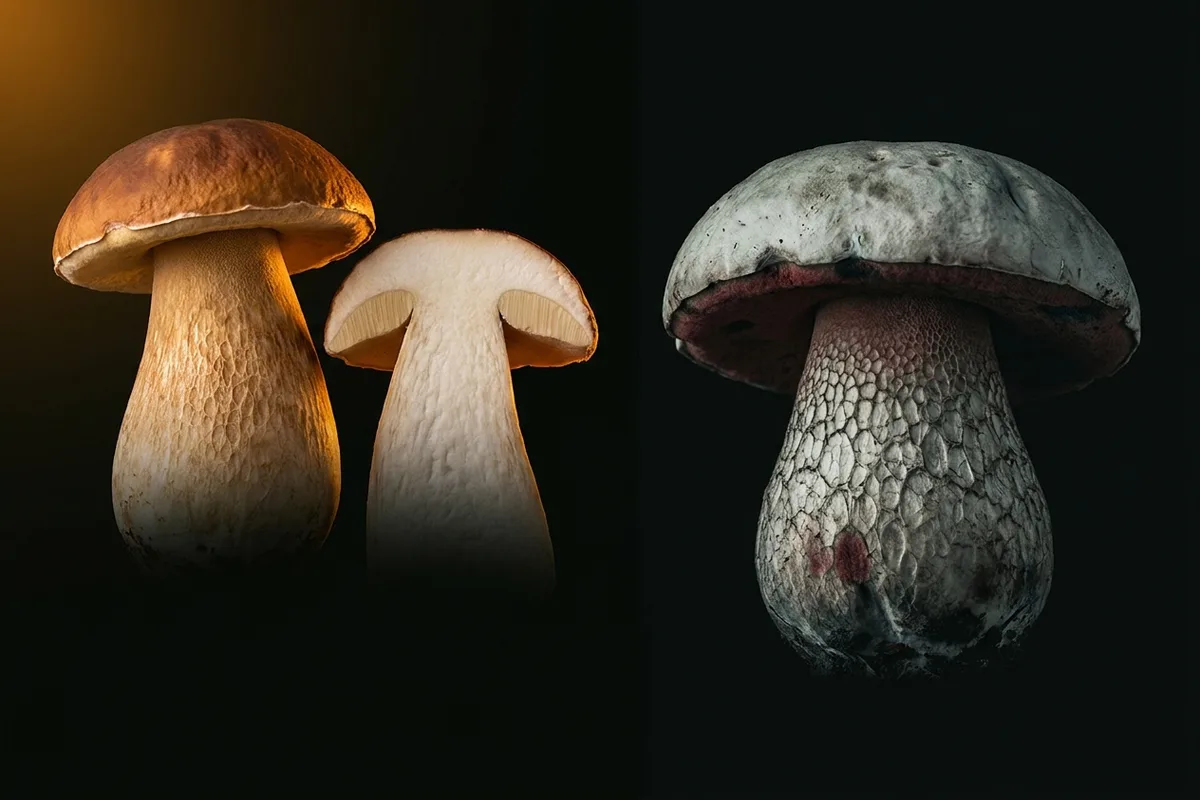
The porcini, Boletus edulis, has a cap ranging from light brown to chestnut, often with a slightly paler, almost frosted rim. Under the cap, instead of gills, it has tubes, which are white in young specimens, turn cream with age and finally become greenish-yellow. This matters, because no bolete with young tubes in yellow or red is a porcini.
The porcini stem is pale, beige to light brown, thick and club-shaped, and covered in a fine, light net. The flesh is white and does not change colour when you cut it: it neither blues nor reddens. The smell is pleasant, nutty and mushroomy.
Where the devil’s bolete differs
The devil’s bolete, Rubroboletus satanas, can look similar to a porcini at first glance because of its bulky build and pale cap. The other features, however, clearly set the two apart. Its cap is dirty white, greyish or cream and only rarely brown like a porcini’s. The most important differences are in the pores and the stem: the pores range from orange-red to blood-red, and the bulbous stem carries a red net over a yellowish ground and is often clearly red in its middle part.
The cap is brown to chestnut, and its rim is often paler.
The tubes are white at first, then cream, and finally greenish-yellow.
The pale stem is covered in a fine light net.
The flesh is white and does not change colour when cut.
The cap is dirty white, greyish or cream.
The pores range from orange-red to blood-red.
The stem carries a red net over a yellowish ground.
The flesh slowly blues when cut.
The test that settles it
The simplest thing you can do in the field is look under the cap and cut the stem in half. Those two observations resolve it faster than any description.
Pore colour: white, cream or yellow-green pores are a good sign, while red or orange pores are a signal to put the mushroom down.
Flesh reaction: a porcini stays white, while the devil’s bolete slowly blues.
Stem: the porcini has a light net, while the devil’s bolete has a red one.
Habitat: the devil’s bolete favours warm, calcareous soils and deciduous woods with oak or beech, mostly in the south.
Red or orange pores on a bolete are always a warning sign. Some red-pored boletes are edible only after cooking, some are toxic, and a beginner cannot tell them apart reliably. The safest rule is simple: a bolete with red pores stays in the forest.
The devil’s bolete rarely ends up in a basket by mistake, because once you know what to look for, it clearly differs from a porcini. Eaten raw or in quantity, it causes violent gastrointestinal symptoms. It is not as dangerous as the deadly death cap, but poisoning with it is very unpleasant.
Most mistakes come from haste. As the basket fills, foragers judge a mushroom by its silhouette and stop checking the other features. Make it a habit to look under the cap before a mushroom goes in the basket. The check takes five seconds and can spare you a bout of poisoning.