The chanterelle is one of the most popular wild mushrooms: it rarely goes maggoty, it keeps for days, and it is hard to confuse with anything dangerous, although confusion is possible. Two other mushrooms resemble the chanterelle, and one feature lets you tell them apart.
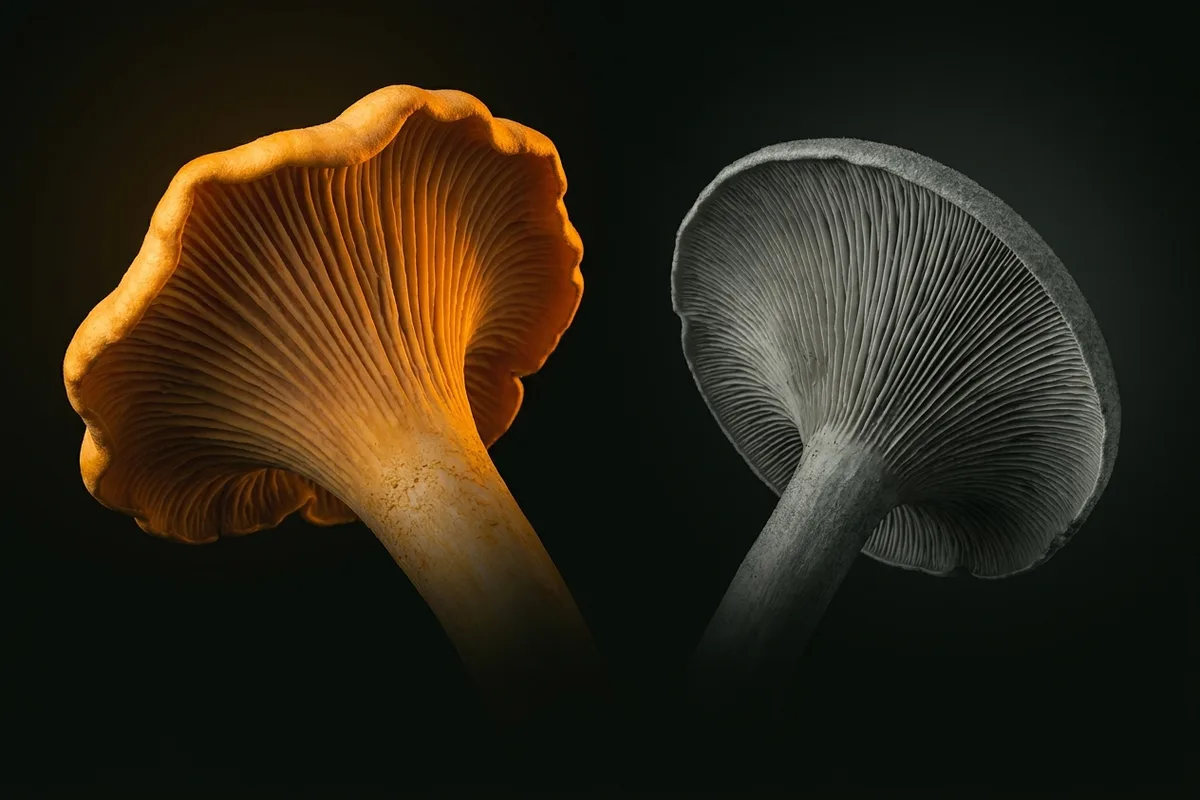
The chanterelle: ridges instead of gills
The chanterelle, Cantharellus cibarius, has a uniform yellow-orange colour across the whole fruit body: cap, stem and underside alike. The cap is convex at first, then funnel-shaped, with a wavy, inrolled margin. The most important feature is on the underside of the cap: instead of gills, the chanterelle has thick, forking ridges, that is, folds that run smoothly far down the stem. The flesh smells fruity, faintly of apricot, and does not turn blue.
The false chanterelle: a less dangerous lookalike
The false chanterelle, Hygrophoropsis aurantiaca, is aptly named. It has a more intense orange colour and a velvety cap, and under the cap it has true gills: thin, crowded and regularly forked, and sharply set off from the stem. It is not deadly, but it causes stomach upsets in some people, and it does not taste like a chanterelle.
Omphalotus olearius, the jack-o’-lantern, is more dangerous. It grows in clusters on wood and stumps and has sharp, crowded, non-forking gills. In Poland it is rare and heat-loving, but confusing it with a chanterelle leads to severe poisoning. You tell it apart in the same way: by its gills instead of ridges and by the substrate, because a chanterelle grows from the soil and the jack-o’-lantern grows from wood.
The whole fruit body, including the stem and underside, is uniformly yellow-orange.
It has thick, forking ridges that run down the stem.
It smells fruity, faintly of apricot.
It grows from the soil, singly or in groups.
It is intensely orange and has a velvety cap.
It has thin, crowded, regular gills, sharply set off from the stem.
It smells bland, without a fruity note.
It often grows on conifer litter and rotting wood.
How to tell a chanterelle from its lookalikes
Underside of the cap: a chanterelle has thick, blunt, forking ridges, and a false chanterelle has thin, sharp gills.
Transition to the stem: on a chanterelle the ridges run smoothly down, while on a false chanterelle the gills end sharply.
Substrate: a chanterelle grows from the soil, and clusters on wood are a warning sign.
Smell: a chanterelle smells fruity, while its lookalikes smell bland or have no distinct smell.
The chanterelle is a mycorrhizal mushroom and grows from the soil, in symbiosis with trees, never massed on a trunk or log. Treat bright orange mushrooms that grow in clusters straight from wood with suspicion, even if from a distance their colour resembles a chanterelle’s.
Once you learn to look at the ridges instead of the colour, the chanterelle becomes one of the safest mushrooms in the forest. For this reason it is recommended to beginners, but the advice only holds if you know the difference between a ridge and a gill.
Cut a chanterelle lengthwise in half. A true chanterelle is pale, fibrous and solid inside, and the colour of the ridges passes smoothly into the stem. The cut also shows any maggot tunnels, although chanterelles rarely have them.