After a downpour many foragers head to the forest the very next day and come back with an empty basket. The mycelium needs time: after rain it forms primordia, and the fruit bodies push through the litter only several days later. This guide describes what a flush depends on and how you can judge from the weather of the past two weeks whether the coming weekend is worth a trip.
A fruit body needs time
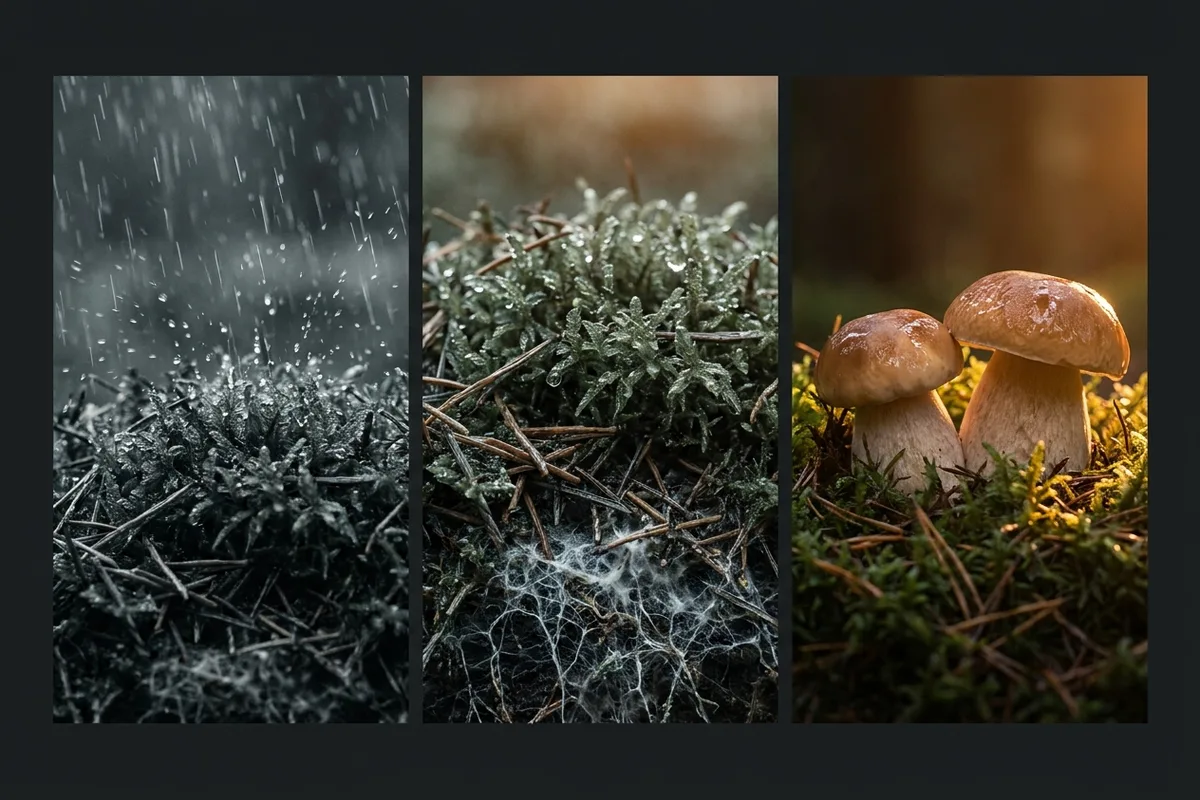
Foragers pick fruit bodies, which grow from the mycelium. The mycelium, a network of threads in the soil and litter, is the fungus itself and lives in one place for many years. A heavy rain after a dry spell stimulates the mycelium to grow, but fruit bodies do not form overnight. The mycelium first forms primordia, and these push through the needles and moss only later. In most species of Central European forests the first fruit bodies appear about a week after the rain, and most of them come up between day 7 and day 12.
Rain from two or three days ago has not yet turned into fruit bodies. The litter is wet, but the mycelium is only forming primordia.
The best period starts about a week after the rain and lasts several days. This is when the first and usually the largest wave of fruit bodies appears.
After two and a half weeks without further rain the litter dries out and the flush fades.
What counts is the total rainfall in this period. The index in the app gives the rain component its full value once the weighted total reaches 25 millimetres.
The chart shows how the app weighs rain in the conditions index. Rain from the last three days has zero weight. Rain from 7 to 12 days ago has the highest weight, and after 18 days rain no longer counts.
Temperature, frost and air humidity
Rain alone is not enough: most species fruit best when the average temperature of the past week is between about 10 and 20 °C. In hot weather the litter dries out before the mycelium can use the water, and in cold weather growth slows down markedly. Frost stops fruiting in most species, although the velvet shank and the oyster mushroom also fruit on frosty days. Air with a relative humidity above 80 percent keeps the litter moist for longer.
Weather and season work together
In May and in September the same rain is followed by different species. In spring morels and thimble morels come up after rain, and in autumn porcini, bay boletes and honey fungus appear. For this reason you always check the conditions together with the season calendar. The calendar shows which species are in season or at their peak in a given week, and the conditions index shows whether the weather favours them. Late September is the richest time of the year: more than 60 edible atlas species are in season then.
The calendar shows every atlas species week by week: when it starts to grow, when it peaks and when its season ends. It also shows the poisonous look-alikes that grow at the same time.
The conditions index in the app
The Grzybiarz app applies this rule for you. The “Mushroom conditions” card takes measurements from the nearest of 59 synoptic stations run by IMGW, the Polish weather service, or from a station you choose yourself, for example the one closest to the forest you visit. From these measurements the app calculates a score from 0 to 100. A score of 70 or more means favourable conditions, a score from 40 to 69 means that mushrooms may grow, and a score below 40 means poor conditions.
The components of the score are always shown next to it: the weighted rain from 3 to 18 days ago, the average temperature of the week, frost and humidity. The card also describes the most important rain in one sentence, for example: “The heaviest rain was 11 days ago, 18 mm. A good gap, mushrooms should be coming up.”
The strip with the score for today and the next five days uses the weather forecast. Rain forecast for today raises the score only several days later, so the strip shows whether the coming weekend or the following one looks better.
The notification about conditions after rain arrives when it becomes wet and warm near your chosen station. The app chooses the station on the phone and does not send your location anywhere.
A new station needs 18 days of measurements before it shows a score. Until then the card says that it is collecting data.
Measurements come from IMGW-PIB, and the forecast comes from OpenWeather. The app keeps the last reading, so you still see it in a forest without signal.
What the index does not take into account
The index describes the weather at a measuring station and does not account for the conditions in a particular forest: terrain, soil type, stand density or a local storm that the station did not record. It does not point to places and does not predict a flush of a particular species. It tells you whether the area around the station has recently been wet and warm enough for the mycelium to fruit. All stations are in Poland, so outside Poland the index is useful only near the Polish border. For this reason the app always shows the components of the score and leaves the assessment of the forest to you.
Weather that favours porcini and parasols also favours the death cap and the devil’s bolete. At the peak of the season more species grow in the forest at the same time than in any other period, so the risk of a mistake is highest then. The season calendar shows which poisonous look-alikes grow in a given week together with the edible species. If you have any doubt, show your harvest to a mushroom expert.
Note the dates of heavy rain and of your first finds. After one or two seasons you will notice patterns at your own spots: in some forests fruit bodies appear a week after rain, while in others, on sandy soil, the litter dries out faster, so you plan your visits there earlier. The finds log in the app records the date and place automatically, and the calendar later shows what you found a year ago at this time.